

Reinstate the Draft
Make Wars Constitutional Again.

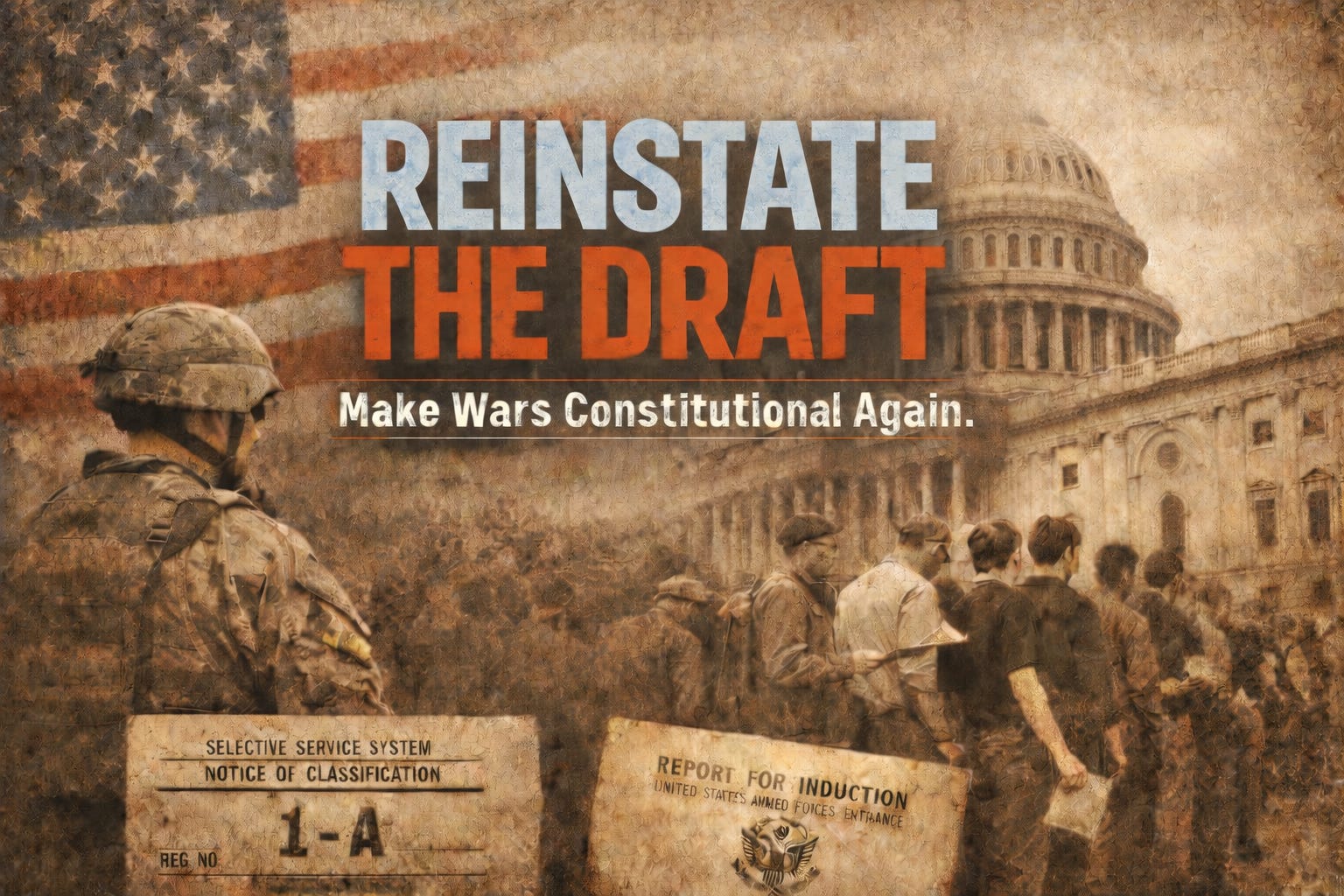
The ongoing US military operations against Iran constitute the ultimate war of choice. They weren’t prompted by a strike against our nation, as at Pearl Harbor. They weren’t unleashed in anticipation of an imminent attack.
The war was initiated on the orders of one individual, the president.
There was no declaration of war from Congress, as required in the Constitution. There was no congressional authorization whatsoever. The president provided notice after the fact, with no justification offered for the delay.
President Trump declines to acknowledge that the US is at war. He’s coined a new term for this enterprise: an “excursion.”
This is an improvisation on a familiar dodge. Since the end of the Second World War, presidents sought rhetorical refuge in an array of euphemisms: “police action,” “conflict,” “incursion,” “peacekeeping,” “rescue mission,” “kinetic military action,” “overseas contingency operations,” and so on.
This has been accompanied by fading congressional oversight. Democrats and Republicans alike tend to limit their demands for accountability to presidents of the opposing party.
In our 250th year, the United States has come full circle: Presidents hold unchecked war powers, more like George III than George Washington.

The Forever War Political Economy
The post 9-11, “forever war” era has been fueled by an overarching sensibility, that the resources of the United States are unlimited.
With a defense budget approximating a trillion dollars, the US far outspends other nations. Amid the new Iran conflict President Trump has proposed increasing that by half.
The capacity to incur debt without short-term consequences arises from the dollar’s position as the global reserve currency. In addition, in 1971, to finance the Vietnam War, President Nixon decoupled the dollar from gold. This granted generations of politicians a credit card without payment due dates.
Presented as a libertarian alternative to the draft, the AVF defused widespread campus protests. Going forward, it reduced the political costs of recruiting and deploying personnel. Rather than conscripting often unwilling young men, the military would benefit from higher quality, more dedicated volunteers.
These two Vietnam-era innovations enabled successive presidents to unilaterally undertake ever more foreign engagements. As in other areas of executive branch overreach, President Trump has taken preexisting tendencies to extremes that can no longer be overlooked.

Reinstate the Draft
Would you encourage young people to enlist in the AVF today? Would you be comfortable with their assuming a multi-year service obligation amid our ongoing forever wars?
Imagine if there were a universal draft. Would you be comfortable having family or friends and others conscripted for the Iran conflict?
For far too long, Americans have acceded to a self-sustaining war machine that relies on a small cohort of patriotic citizens shouldering a disproportionate burden in military campaigns in faraway, unfamiliar countries, in pursuit of goals we can’t articulate, without metrics we can evaluate.
If all young people—including the families and friends of our politicians—were subject to the draft, would decisionmakers demand more effective strategy and execution of military interventions?
Regrettably, there appears to be insufficient appreciation for the risks and sacrifices of our volunteer forces.
While American casualty numbers in the Iran campaign are rising, some commentators minimize them as an argument for further intervention. Mark Levin argues that the relevant comparison is with the horrific battle for Okinawa in the wrap-up of the Second World War.
The differences are stark. That was a declared war, in response to an attack on our nation, supported by a draft, overseen assiduously by Congress. Military and related civilian service was universal. This included the family of the president, as well as members of the House and Senate and their families.
There’s also a largely unspoken rationalization that today’s military, being volunteers, assumed the risks. What they did not assume was the risk of being deployed at the whim of presidents. Soldiers swear to defend our Constitution; they should be able to rely on being led in compliance with the Constitution.
The Time Is Now
The administration declined to comment on the draft status of the president’s 20-year-old son.
After a half-century, the US should reconsider the all-volunteer force. A return to a draft would be in keeping with our citizenship traditions. It might also prompt our political officials to restore the primary, constitutional role of Congress in declaring, financing, and overseeing wars.
Perhaps it would instill caution and encourage public debate about US commitment to wars of choice.
We can conclude our multi-decade excursion into imperial pretensions—and rediscover the legacy of George Washington.
![Washington's Farewell Address [3]](https://substackcdn.com/image/fetch/$s_!71BN!,w_140,h_140,c_fill,f_webp,q_auto:good,fl_progressive:steep,g_auto/https%3A%2F%2Fbucketeer-e05bbc84-baa3-437e-9518-adb32be77984.s3.amazonaws.com%2Fpublic%2Fimages%2F0d4ee677-811a-4d03-a476-7acc6c1f0379_800x800.jpeg)
Thanks, Jim, for starting this necessary discussion. In addition to providing an implicit check on presidential war powers, a draft would help revive our national community spirit by giving everyone a common experience of serving their country. Unfortunately, the current radical libertarian philosophies on the left and right make the likelihood of enacting a draft remote at best.
However, we could get to much the same place by conditioning student grants and loans on prior military service. If the grant program was expanded to offer not just education help but also grants and loans to start new businesses, we would create a new intellectual and business elite that actually appreciated the value of service to the entire nation.